Understanding ATEX Directives: The Complete Guide to Explosion Safety in Hazardous Work Environments
Explosive atmospheres are one of the most dangerous workplace risks in industries like oil and gas, mining, chemical processing, food manufacturing, and more. The mere presence of flammable gases, vapors, or combustible dust in the air can lead to catastrophic accidents if the right precautions aren’t taken. This is where ATEX directives come into play — a crucial set of European Union regulations designed to protect lives, safeguard equipment, and enforce uniform safety standards across hazardous zones.
But what exactly are ATEX directives? How do they apply to real-world industries? What types of equipment require ATEX certification, and how can businesses ensure compliance? In this guide, we’ll take a comprehensive look at everything you need to know.
What Are ATEX Directives?
The term “ATEX” is derived from the French words “ATmosphères EXplosibles,” meaning explosive atmospheres. It refers to a group of EU laws that govern the safe use of equipment in potentially explosive environments. These regulations are not optional. If your company operates in the European Economic Area and handles flammable substances or dust in any capacity, ATEX compliance is a legal requirement.
The ATEX framework is built on two main directives:
- Directive 2014/34/EU (also known as ATEX 114): This directive focuses on the equipment and protective systems intended for use in explosive atmospheres. It applies to manufacturers and ensures that devices sold for hazardous zones are built to prevent ignition.
- Directive 1999/92/EC (ATEX 153): This directive covers health and safety requirements at the workplace. It applies to employers, mandating that they assess explosion risks, implement preventive measures, and ensure that only certified equipment is used in classified zones.
Together, these directives aim to minimize the chance of explosions in workplaces and ensure that both equipment and operations are safe, reliable, and compliant with the highest safety standards.
Why Are ATEX Directives So Important?
The consequences of an explosion in an industrial setting are devastating. In addition to human fatalities or injuries, there are financial losses, legal ramifications, environmental damage, and reputational consequences to consider. ATEX directives exist not just as a regulatory formality but as a critical framework to save lives and ensure responsible operations.
Ensuring Worker Safety
The primary purpose of ATEX directives is to eliminate ignition sources in hazardous environments. This includes electrical sparks, hot surfaces, static discharge, or mechanical failures. Proper implementation of ATEX standards significantly lowers the risk of workplace incidents and injuries.
Legal Compliance and Liability Protection
Compliance with ATEX is mandatory for businesses in the EU that operate in hazardous areas. Non-compliance can lead to:
- Hefty fines
- Equipment confiscation
- Lawsuits
- Work stoppages
- Even criminal charges in the event of serious injuries or fatalities
By adhering to ATEX regulations, companies also demonstrate a commitment to global best practices in safety, which can enhance trust with regulators, employees, clients, and partners.
Long-Term Operational Efficiency
ATEX-certified equipment is specifically engineered to withstand extreme conditions, minimizing the chances of malfunction or downtime. This translates to fewer repairs, reduced maintenance costs, and higher equipment longevity — all while preventing catastrophic failures.
Market Access and Credibility
For equipment manufacturers, having ATEX-certified products is essential for selling within the EU and many other regions. ATEX compliance increases a product’s marketability and helps establish credibility in safety-critical industries.
Understanding Hazardous Area Classifications: The ATEX Zones
A key part of ATEX compliance involves understanding how explosive atmospheres are classified. These classifications — known as ATEX zones — define the level of risk in a given area, and they directly determine the type of equipment that can be safely used there.
For Gases and Vapors:
- Zone 0: An area where an explosive atmosphere consisting of air and flammable gases, vapors, or mists is present continuously or for long periods.
- Zone 1: An area where such an atmosphere is likely to occur in normal operation.
- Zone 2: An area where such an atmosphere is not likely to occur during normal operation, but if it does, it will exist for a short period only.
For Dust:
- Zone 20: An area where a cloud of combustible dust in the air is present continuously or frequently during normal operation.
- Zone 21: An area where a dust cloud is likely to occur occasionally.
- Zone 22: An area where a combustible dust cloud is unlikely to occur in normal operation but may happen for short durations.
These zones help employers and safety managers determine the explosion protection techniques needed — from the right ventilation and electrical systems to approved portable devices and protective enclosures.
What Equipment Requires ATEX Certification?
Any equipment used in a hazardous area must be certified according to its intended use and the zone it operates in. This includes:
- Electrical devices such as lighting, motors, and communication tools
- Mechanical equipment like pumps, compressors, and conveyors
- Control panels, sensors, actuators, and process controllers
- Portable electronics like smartphones and tablets used by field workers
- Protective systems such as explosion isolation barriers and suppression systems
An increasing number of devices — especially smart devices — are being developed with intrinsically safe designs, meaning they are incapable of igniting an explosive atmosphere, even if damaged or subjected to faults.
The ATEX Certification Process
Obtaining ATEX certification involves multiple stages, depending on the complexity and category of the equipment:
- Hazard and Risk Assessment: Manufacturers begin by identifying the environments in which their product will be used and assessing all ignition risks.
- Design to Safety Standards: Equipment must be engineered using ATEX principles, such as flameproof enclosures, intrinsically safe circuits, or pressurization to isolate explosive atmospheres.
- Testing and Evaluation: Depending on the category, products are either self-certified (for low-risk devices) or tested and approved by a Notified Body — an independent certification authority authorized by the EU.
- Technical Documentation: Manufacturers must compile detailed technical files outlining the design, risk assessments, safety calculations, and testing protocols.
- Marking and Labeling: Once certified, equipment is marked with the appropriate ATEX label, which includes the “Ex” symbol, category, zone suitability, temperature class, and gas/dust classification.
- Declaration of Conformity: Finally, manufacturers issue a Declaration of Conformity, stating that the equipment meets all relevant ATEX requirements.
ATEX vs IECEx: Regional and Global Standards
A common question among industry professionals is: What is the difference between ATEX and IECEx?
While both certification systems address the same core issue — explosion protection — there are key distinctions:
- ATEX is mandatory in the EU and is based on EU directives.
- IECEx is an international standard, often required or preferred in countries outside the EU, such as Australia, South Africa, and parts of Asia and the Middle East.
Companies that operate globally often aim to secure both ATEX and IECEx certifications to ensure universal acceptance of their equipment and processes.
Real-World Applications: Rugged ATEX-Certified Devices
In high-risk environments, reliable communication and data collection are critical. But most consumer-grade devices are not designed for explosive atmospheres. This is why ATEX-certified smartphones, tablets, and wearables are now widely used across hazardous industries.
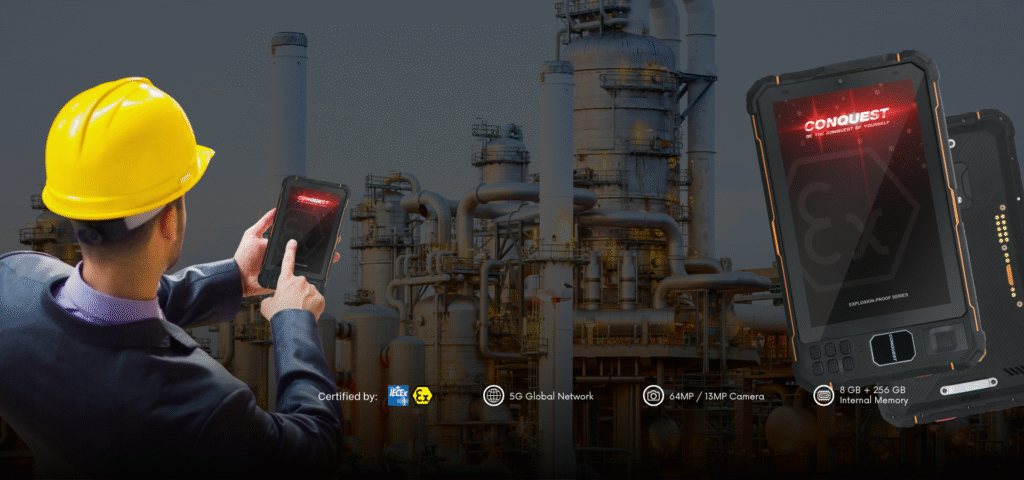
For example, Conquest’s ATEX-certified smartphones are built with advanced safety features, including:
- Intrinsically safe design
- Sealed enclosures to prevent dust or vapor entry
- Glove-compatible touchscreens
- Rugged durability for extreme weather and mechanical impacts
- Long battery life for field use
Such devices enable workers to capture data, communicate in real-time, access documentation, and use augmented reality applications — all without compromising on safety.
Industries Where ATEX Directives Are Essential
Oil and Gas
Offshore rigs, refineries, and pipeline operations are surrounded by volatile gases and must use fully certified equipment to avoid devastating fires or explosions.
Chemical and Pharmaceutical
Many solvents and chemicals used in manufacturing are highly flammable. ATEX-compliant machinery ensures safe mixing, storage, and transfer.
Mining
Underground mines face constant risks from methane, coal dust, and confined environments, making explosion protection a matter of survival.
Food and Agriculture
Industries like sugar refining, grain milling, and animal feed production deal with combustible dusts that can create powerful explosions when suspended in air.
Woodworking and Textiles
Dust created during manufacturing and processing is often fine and highly flammable. Proper ventilation, filtration, and certified equipment are key.
Conclusion
Explosion hazards are among the most dangerous and unpredictable threats in modern industry. But with the right knowledge and practices, they are also among the most preventable.
ATEX directives offer a structured, enforceable pathway to reduce risk, enforce consistency, and promote safety in environments where the stakes are incredibly high. Whether you’re a facility operator, a safety engineer, a manufacturer, or a technician on the ground, understanding and implementing these directives is not optional — it’s a non-negotiable component of responsible business operations.
Compliance isn’t just about ticking a box. It’s about investing in the future of your workforce, your assets, and your company’s reputation. In hazardous zones, ATEX is not just a directive. It’s a lifeline.
More Interesting Posts

Conquest EX102 Rugged Tablet: Explosion-Proof Industrial Mobility for Hazardous Environments
How Conquest EX202 Enhances Operational Efficiency with Built-In Tools
Enhancing Worker Safety with Conquest EX201’s Satellite Communication